
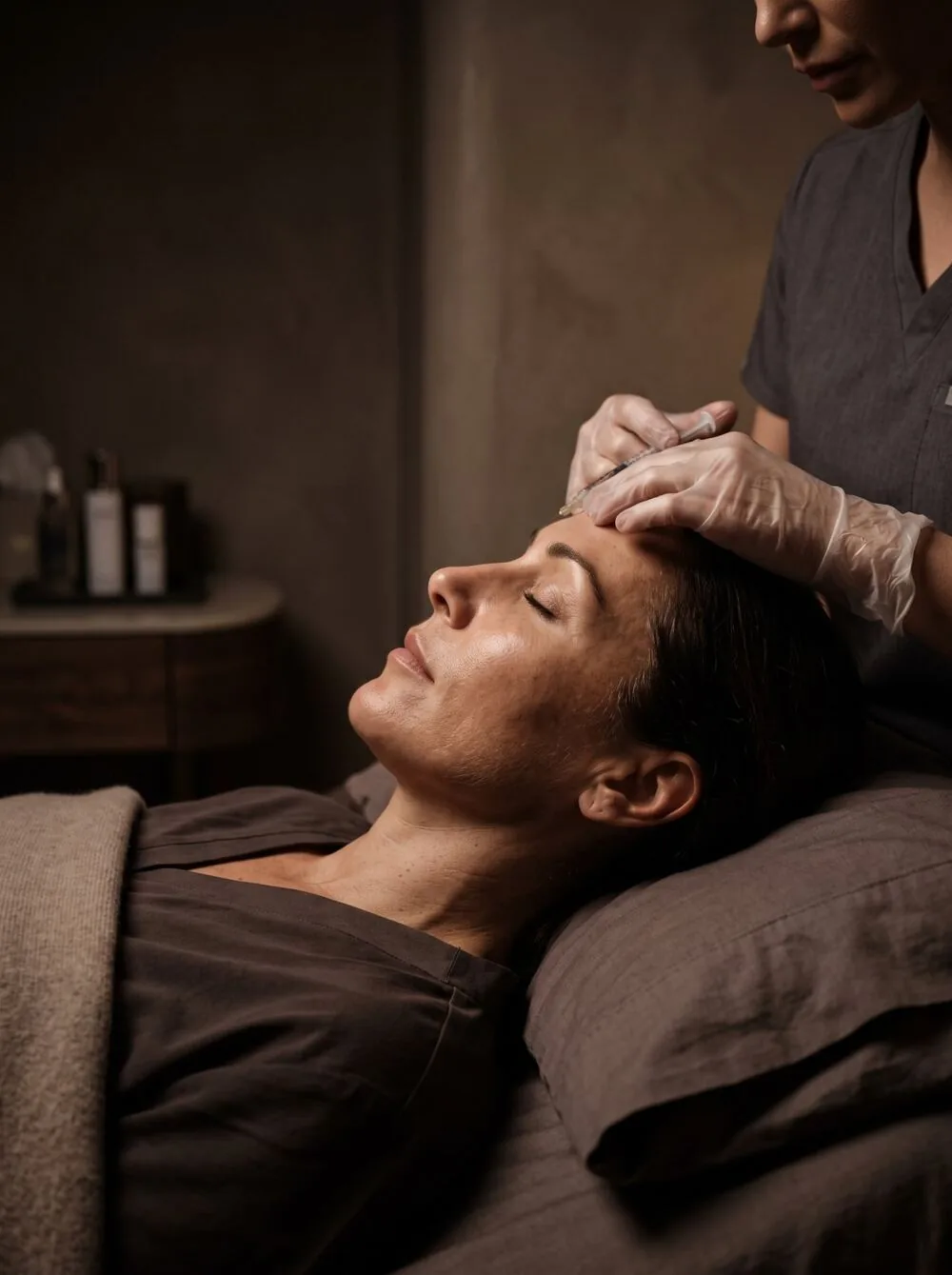
It is one of the questions we hear most in the consulting room: is my concern treated with neuromodulators or with hyaluronic acid? The answer depends on what is causing what you see in the mirror. Both treatments are injectables and both are applied to the face, but they act on very different things.
Neuromodulators: when the wrinkle is caused by expression
Some wrinkles appear when the face moves: when frowning, raising the eyebrows or smiling. They are called dynamic wrinkles and are caused by the repeated contraction of certain facial expression muscles.
Neuromodulators temporarily reduce the strength of that contraction. When well indicated, the result is not an immobile face: it is a more rested expression, with less marking on the forehead, between the brows or at the crow’s feet.
- Mainly indicated for expression lines in the upper third of the face.
- The effect becomes visible in the days following the session.
- It is temporary: the muscle gradually regains its strength, and the treatment is repeated according to medical judgement.
Hyaluronic acid: when volume or hydration is lacking
Other wrinkles and folds are visible even when the face is at rest. With age, the skin loses hydration and support, and some areas lose volume: the cheekbone, under-eye hollows, the nasolabial fold or the lips.
Hyaluronic acid is a substance that the body itself produces. Depending on its formulation, it is used to restore volume, define or hydrate the skin in depth. Its effect is immediate and it is gradually reabsorbed over time.
Often, the answer is a combination
A face does not age for a single reason, so the plan rarely involves a single treatment. It is common to treat the forehead with neuromodulators and the mid-face with hyaluronic acid, or to add treatments that improve skin quality, such as facial mesotherapy.
What matters is the order and the dose: treat what is needed, in the right measure, so that the result looks natural.
What makes the difference: the assessment
Before recommending any injectable, we analyse your anatomy, your expression and your medical history. In some cases we use dermo-aesthetic ultrasound to see the structures beneath the skin and work with greater safety.
If you are not sure what you need, that is precisely the purpose of the first visit: to listen to you, assess your case and explain the options, without obligation.